
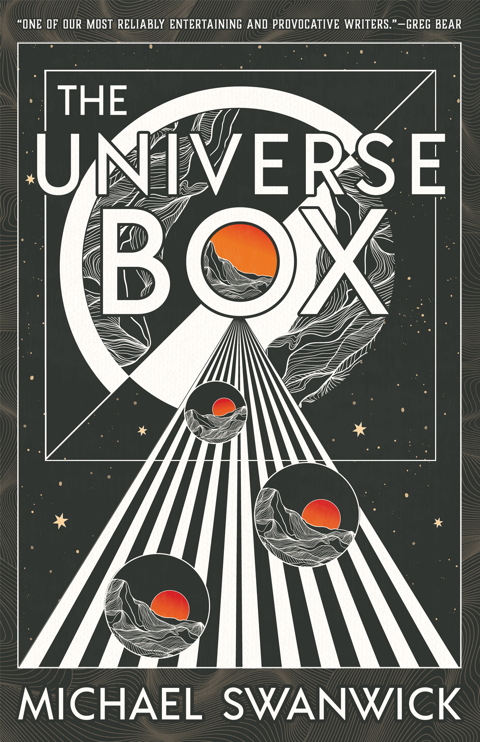

I started reading Michael Swanwick in the 1980s, but it was only after I read his latest collection, The Universe Box (Tachyon, 3 Feb 2026) that I finally figured out what he’s doing.
The Universe Box collects nineteen stories published since Swanwick’s last collection, Not So Much, Said the Cat (Tachyon, 2016). Like that previous collection, there are no weak stories here. Two are originals; you might have seen the others in Asimov’s, Clarkesworld, or F&SF (three each), on Tor.com (two) or elsewhere, and as Gary K. Wolfe notes in his Locus review, ten have already appeared in The Best of Michael Swanwick: Volume Two (Subterranean, 2023). These stories are his usual mix of darkness and mischief, ranging from sword and sorcery to Analog-grade hard sf; there’s the expected Russian story and paleontology story (featuring Dimetrodon, so: not a dinosaur story), two unexpected takes on gender themes, and two clever time travel puzzles (one sf, one sword and sorcery). Several are in conversation with sf classics (“Artificial People”, “The Warm Equations”), sf writers (“Huginn and Muninn—and What Came After”) or Swanwick’s earlier work (“Annie Without Crow”, an Elizabethan sequel to his 2000 story, “The Raggle Taggle Gypsy-O”).
If you read enough Swanwick—and by this point there’s a lot to read: The Universe Box is the fifth of his “core” short fiction collections,1 to say nothing of his novels—you notice certain things recurring. Confidence men, dinosaurs, Russians, trickster gods. Exemplary worldbuilding: when he writes science fiction, the science is phenomenally rigorous; when it’s fantasy, it’s not remotely extruded. Elegant writing at the sentence level, along with a steadfast commitment to craft and to story, such that the author tells us to pay no attention to the man behind the curtain. “My stories are like snowflakes―no two alike. Their author doesn’t matter, only what serves each one best,” he says in one interview. In another, discussing “Cloud” and “Dragon Slayer” (both found in The Universe Box), the interviewer Alvaro Zinios-Amaro observes: “Give these two stories, without a byline, to any reader and I’m sure they’d bet they were by different writers.”2 You could likely say the same of any other pair or trio of stories in The Universe Box. When someone says that no two Swanwick stories are alike, it’s not necessarily hyperbole.
But it’s what Swanwick does with his characters that merits a closer look.
Back in the days of Usenet, I expressed my enthusiasm for his 1993 novel The Iron Dragon’s Daughter (which at that point had only been out for a year or two) on rec.arts.sf.written, only to have someone respond that they couldn’t get into the book because they had trouble identifying with the protagonist, Jane, on account of her not being a very good person.
I had not been aware that this was required.
It clicked while reading The Universe Box: Jane’s unlikeability was not an accident. There was something in common with nearly all of Swanwick’s protagonists. They were are almost never heroes or role models. Often they’re losers and mediocrities, to varying degrees, with the bad luck to encounter the transcendent. Mischling, the mouse transformed into a woman to serve three wicked giants before the rising of the Sun in the Icelandic-myth-inspired “Last Days of Old Night.” The homeless Luke, unable to meet the moment when a cthonic menace surfaces in “Dreadnought.” Or Howard, the dull schlub in “The Universe Box” whose receipt of a cigar box containing the universe thanks to a renegade trickster god leads to hijinks that may or may not do something about the dullness and/or schlubbiness. They do not necessarily make the best choices.
Sometimes, though, they’re literally the worst people. In three stories the protagonist has killed or plans to kill their spouse (which I infer from what I know of Swanwick—we’ve met—that this is the worst thing he can imagine). But, and here’s the thing, they’re not necessarily villains either, at least not completely: there is always some kernel of humanity, some remorse, some self-awareness, some chance at growth, even in the worst people. Toward the end of “Cloud,” a story that dissects the ephemerality of the ruling class, one character worries: “We’re good people aren’t we? Tell me we are.” (The question answers itself.) In “The Warm Equations,” Swanwick flips the logic of Tom Godwin’s “Cold Equations”—the trolley-problem story to which every sf writer must apparently have a response—by giving us a deeply unlikeable man whose colleagues nevertheless put themselves at risk to rescue.
“The Warm Equations” feels like a profession of faith. These character choices are not, I think, accidents. In many ways Swanwick’s work can be taken as an exploration of the messy, ignoble humanity of the worst and least of us. As an atheist with a Presbyterian background I am likely the least qualified person to make this assessment, but this deeply humane sensibility strikes me as an awfully Catholic thing. Swanwick has referred to his Catholic upbringing as a way of explaining his interest in mysticism and transcendence,3 but it’s the question of redemption, which turns up again and again in his work (though often as not as a missed opportunity), that is most striking, and worth examining.
To declare Swanwick a chameleonic writer4 misses the point. It’s insufficient. A ghostwriter is chameleonic—but also invisible. What they mean by that is that he contains multitudes—a universe of stories in a writer-shaped box. Even so, regardless of the differences in genre, setting and tone you find across Swanwick’s œuvre, there is, not so much a sameness, but a consistent sensibility, a Weltanschauung, to his work. It may be that no two snowflakes are alike, but all snowflakes are made from the same stuff: a scintillating crystal, formed around a speck of impurity.
For other perpectives on The Universe Box, see Paul Weimer’s review at File 770 and Gary K. Wolfe’s review in Locus.
I received an electronic review copy from the publisher via Netgalley.
Footnotes
-
The previous “core” collections are Gravity’s Angels (Arkham House, 1991; reprint Tachyon, 2001), Tales of Old Earth (Tachyon, 2000), The Dog Said Bow-Wow (Tachyon, 2007), and Not So Much, Said the Cat (Tachyon, 2016). A tallying of the “non-core” collections would require a footnote longer than this review.
-
Alvaro Zinos-Amaro, Being Michael Swanwick (Fairwood, 2023), p. 339.
-
Zinos-Amaro, Being Michael Swanwick, pp. 149 and 362.
-
Gardner Dozois, “Michael Swanwick: The Chameleon Eludes the Net,” in Swanwick, Moon Dogs (NESFA Press, 2000), pp. 11-15. Moon Dogs is one of those “non-core” collections; it’s out of print.